Canada Trip Highlights Cultural Differences, Similarities
Honors class combines policy, art history and more; special Albion events set for April
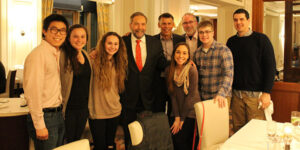
From left: Matt Stander, Megan Bricely, Leah Zawerucha, Tom Mulcair (leader of Canada’s New Democratic Party), Hassan Yussuff (Canadian Labour Congress president), Rachel St. Pierre, Patrick McLean, Noah Pappas and Chris Hagerman, a former Albion history professor now teaching in Ottawa. The group met for dinner at an Ottawa restaurant.
By Chuck Carlson |Read about the April 5-6 events
Patrick McLeanhas long been fascinated with our neighbors to the north.
“I’ve had an interest in Canada for 30 years,” says McLean, the director of Albion College’sGerald R. Ford Institute for Leadership in Public Policy and Service. “In 1985, I did my undergraduate honors thesis on Nova Scotian provincial politics.”
From there he was hooked on a country whose culture and people are in so many ways similar to the United States but, in other key ways, are so different.
And this spring semester, he has taken his love of all things Canada to the classroom, teaching aPrentiss M. Brown Honors Programclass for first-year and sophomore students called Canada: More than Snow, Hockey and Maple Syrup.
The interdisciplinary course has 15 students, the maximum allowed in an honors course, most of whom thought there was little more to Canada than, well, snow, hockey and maple syrup.
“It’s meant to be an introduction to students who have lived next door to this place but don’t know much about it,” McLean says. “It’s not the 51st state. We look at ways we’re similar and ways we’re different. You understand your culture through the lens of another culture.”
Firsthand View
So in an effort to educate and enlighten in a face-to-face way, McLean organized a spring-break trip March 5-12 to Canada, visiting the provinces of Ontario and Quebec and the cities of Ottawa, Toronto, Port Hope, Peterborough and Kingston.Five students—first-years Matt Stander, Leah Zawerucha, Megan Bricely and Noah Pappas and sophomore Rachel St. Pierre—joined McLean and Ford Institute CoordinatorAmy Everharton the excursion.
The group of seven toured such wide-ranging sites as theCanadian Canoe Museumin Peterborough and theHockey Hall of Famein Toronto, and sat in on Question Period in the House of Commons in Ottawa.
They also focused on the works and impact of the iconic Canadian landscape artists from the early 1900s collectively known as the Group of Seven.
The work of the artists—Lawren Harris, J.E.H. MacDonald, A.Y. Jackson, Frank Johnston, Arthur Lismer, Franklin Carmichael and A.J. Casson—are known to most Canadians and their work has long been a source of pride.
And that was a topic that intrigued McLean and his students.
“What creates a country?” McLean asks. “What makes Canada Canada? It’s been described as a land with too much geography, so how do you bind all those people together? The Group of Seven is meant to answer part of that question. It was their landscape art that showed the great outdoor wilderness area and the power of nature.”
Their art, in fact, can be found in museums throughout the country, including at the National Gallery of Canada in Ottawa, another of the group’s stops.
And in April, some of that Canadian heritage comes to Albion College, thanks to Albion alumni Richard Wells, ’67, and Dennis Moore, ’70.
April 5 and 6: Lecture, Address, Film Screening
Wells has been longtime friends withGary and Joanie McGuffin, the Canadian adventurers and conservationists who recently completed the documentary filmPainted Land: In Search of the Group of Sevenwith award-winning documentary film producer White Pine Pictures. Over the course of several months, McLean, Albionart historyprofessor Bille Wickre and Wells were able to arrange a lecture and screening of the film with the McGuffins.
The lecture isTuesday, April 5 at 7:30 p.m.in Bobbitt Auditorium; the film screening is April 6 at 7:30 p.m. at the Bohm Theatre in downtown Albion. Both events are free and open to the public.
According to theWhite Pine Pictureswebsite, this will be the first U.S. showing of the documentary after a year of coast-to-coast cross-Canada screenings. A second U.S. screening is set for April 21 at the Flint Institute of Art.

The Albion students take time for a photo on the Toronto subway.
Meanwhile, Moore, the public affairs officer for the Consulate General of Canada in Detroit, has arranged forConsul General Douglas Georgeto speak at Albion on Wednesday, April 6 at 4:30 p.m. in the Kellogg Center’s Gerstacker Commons. George’s address is also free and open to the public.
It is a circumstance that couldn’t make McLean any happier.
“I was on cloud nine,” he says. “My hope is this will lead to a renewing of our connection with Canada. It reminds us of our own common Great Lakes heritage.”
As for the recent trip to Canada, it left no doubt in the mind of one student where her future lies.
“The trip meant everything,” says St. Pierre, from Troy, Michigan. “[Classmate] Megan and I both have a desire to move up there, and this trip was mind-opening. Before, I thought I wanted to move to Canada, now I know I do.”